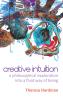
Creative Intuition: A Philosophical Investigation into a Fluid Way of Being
Keywords:
Creativity, Creative intuition, Arts practice, Art-making, Zen flow, SubconsciousSynopsis
Overseas: Copublished with Routledge. Printed book: 9781041294863 E-book: 9781003769798 HB: 9781041294832
Buyers outside South Africa: Click here to access the Routledge website
Buyers in South Africa: Unisa Press IBSN print copy: 978-1-77615-230-8 SA Price: 320. Orders: morodjm@unisa.ac.za
Softcover, 198 pp.
ABOUT THE BOOK
'In Hardman’s rigorous intellectual study, I find validation and support for approaches to creativity that do not prioritise idea-led work or the rational brain. It recognises the embodied experience – a fluid way of being; processes that avoid a neat, graspable, linear path by detouring, expanding and tapping into what is unique and deeply personal in each of us. As Hardman says, creative intuition “calls for a more anarchic state of mind in which we tolerate seemingly irrelevant thoughts and hold in our minds possibly conflicting thoughts. It means being comfortable with uncertainty and ambiguity.”
'This book invites artists and teachers to embrace this necessary uncertainty, and it gives us the tools to defend a way of being that resists the rigid confines of so many educational structures. … this text – passionate in its mission – is a gift of encouragement to create learning spaces and experiences where students feel confident to explore beyond rational thought. … ”. Extract from the Foreword by Chloe Briggs, Founder of Drawing is Free www.drawingisfree.org
The teaching of the creative arts in an academic context is relatively complex and may be seen as problematic because the creative process includes both rational and non-rational aspects. The rational aspects of creativity, such as cognitive strategies and skills development, are addressed overtly in university courses, but the non-rational aspects of the creative process, such as intuition and imagination, are often not discussed due to a lack of understanding. Creative intuition, in particular, is seen as 'mystical' and inexplicable, because it is not based on reason or logic.
This book aims to clarify an understanding of the nature of creative intuition through an exploration of psychological and philosophical research on the subject. It is an attempt to demystify how intuition works during the creative process. Key principles underlying creative intuition are presented, as well as suggestions for ways to nurture creative intuition.
The book cover and book inside feature original watercolour images (mostly of an abstract, modernist nature) created by the author herself, who is also an artist.
References
Abe, M. 1989. Zen and Western Thought, edited by W.R. LaFleur. Honolulu: University of Hawaii Press.
Ahsen, A. 1992. New Surrealism: The Liberation of Images in Consciousness. Los Angeles: Brandon House.
Ames, R.T. and Hall, D.L., trans. 2003. Dao De Jing: A Philosophical Translation. New York: Ballantine Books.
Ashton, K. 2015. “The End of Creativity.” Medium, 9 Mar 2015. https://medium.com/how-to-fly-a-horse/the-end-of-creativity-cc5c27e7e42d.
Baars, B.J., Banks, W.P. and Newman, J.B., eds. 2003. Essential Sources in the Scientific Study of Consciousness. Cambridge, MA: MIT Press.
Ball, E. 2013. Painting. Brighton, UK: Emily Ball at Seawhite.
Ball, E. 2018. “Floribunda Online Course.” https://emilyballatseawhite.co.uk/courses/contemporary-art-courses/all-our-courses/427-floribunda prerecorded.html.
Ball, E. 2019. “Floribunda.” YouTube, 27 Jun 2019. https://www.youtube.com/watch?v=UT36PehQjPc&list=PLFEoAitQpFf_oEu5v7c6tR-1s VALMKPQ&index=4.
Barrett, M.J. and Wuetherick, B. 2012. Intuition and Animism as Bridging Concepts to Indigenous Knowledges in Environmental Decision-making. https://www.researchgate.net/publication/233729730_Intuition_and_animism_as_bridging_concepts_to_Indigenous_knowledges_in_environmental_decision-making
Bastick, T. 1982. Intuition: How We Think and Act. Chichester, New York: Wiley.
Benton, R.P. 1966. “Keats and Zen.” Philosophy East and West 16 (1): 33–47.
Berens, L. 2013. The Sixteen Personality Types. https://lindaberens.com/resources/methodology-articles/the-sixteen-personality-types/
Bergson, H. (1889) 2012. Time and Free Will: An Essay on the Immediate Data of Consciousness, translated by F.L. Pogson. Chelmsford, MA: Courier Corporation.
Bergson, H. (1896) 2012. Matter and Memory. New York: Dover Publications.
Bergson, H. (1907) 1998. Creative Evolution, translated by A. Mitchell. Mineola, NY: Dover.
Bergson, H. (1914) 2013. Laughter: An Essay on the Meaning of the Comic, translated by C. Brereton and F. Rothwell. Basingstoke: Macmillan.
Bergson, H. (1932) 2010. The Two Sources of Morality and Religion. Paris: University of Notre Dame Press.
Bergson, H. (1934) 2012. The Creative Mind: An Introduction to Metaphysics, translated by M.L. Andison. Chelmsford, MA: Courier Corporation.
Bogue, R. 2004. Deleuze’s Wake: Tributes and Tributaries. New York: University of New York Press.
Bogue, R. 2016. Deleuze’s Way: Essays in Transverse Ethics and Aesthetics. Abingdon, UK: Routledge.
Bohm, D. 2012. On Creativity, edited by L. Nichol. New York: Routledge.
Bohm, D. and Peat, F.D. 1987. Science, Order and Creativity. New York: Routledge.
Bolt, B. 2010. Heidegger Reframed: Interpreting Key Thinkers for the Arts. New York: I.B. Taurus.
Brod, M., ed. (1948) 1991. The Blue Octava Notebooks of Kafka 1917–1919. Cambridge, MA: Exact Change.
Brooke, R. 1991. Jung and Phenomenology. London: Routledge.
Brosmer, M.P. 2011. “Found: The Holy Grail of Wholeness in Organizational Life.” YouTube, 24 Jan 2011. https://www.youtube.com/watch?v=zBtLAbGqdxo
Brown, J.R., Frappier, M. and Meynell, L., eds. 2013. Thought Experiments in Philosophy, Science and the Arts. New York: Routledge.
Buber, M. (1923) 2004. I and Thou, translated by R.G. Smith. London: A & C Black.
Buckler, W.E. 1961. Novels in the Making. Boston, MA: Houghton Mifflin.
Burkhead, C. 2013. Dreams in American Television Narratives: From Dallas to Buffy. London: Bloomsbury.
Calaprice, A., ed. 2000. The Expanded Quotable Einstein. Princeton, NJ: Princeton University Press.
Cameron, J. 1992. The Artist’s Way. New York: Tarcher.
Capra, F. 1975. The Tao of Physics. London: Harper Collins.
Carbonetti, J. 1998. The Zen of Creative Painting: An Elegant Design for Revealing Your Muse. New York: Watson-Guptill.
Carr, M. 2015. “How to Dream like Salvador Dali,” in Psychology Today, 20 Feb 2015. (blog). https://www.psychologytoday.com/za/blog/dream-factory/201502/how-to-dream-like-salvador-dali
Chang, C-Y. (1970) 2011. Creativity and Taoism: A Study of Chinese Philosophy, Art and Poetry. New York: Harper & Row.
Christon, L. 1990. “Athol Fugard: South Africa is always with Him.” Los Angeles Times, 5 Aug 1990. http://articles.latimes.com/1990-08-05/entertainment/ca-337_1_south
Clark, R.W. 1971. Einstein: The Life and Times. London: Bloomsbury.
Collier, G. 1972. Art and the Creative Consciousness. Englewood Cliffs, NJ: Prentice-Hall.
Conger, J. (1994) 2011. The Body in Recovery: Somatic Psychotherapy and the Self. London: Routledge.
Croce, B. (1965) 1995. Guide to Aesthetics, translated by P. Romanell. Cambridge, MA: Hackett Publishing.
Csikszentmihalyi, M. 1990. Flow: The Psychology of Optimal Experience. New York: Harper & Row.
Csikszentmihalyi, M. 2014. Flow and the Foundations of Positive Psychology.Dordrecht: Springer.
cummings, e.e. and Firmage, G.J. 1967. Miscellany Revised. London: Barnes & Noble.
Currey, M. 2013. Daily Rituals: How Great Minds Make Time, Find Inspiration, and Get to Work. London: Pan Macmillan.
Dacey, J. and Lennon, K. 1998. Understanding Creativity: The Interplay of Biological, Psychological, and Social Factors. San Francisco, CA: Jossey-Bass Wiley.
Dalai Lama. 1991. MindScience: An East–West Dialogue, edited by D. Goleman and R. Thurman. New York: Simon & Schuster.
Dali, S. (1948) 1992. 50 Secrets of Magic Craftsmanship. North Chelmsford, MA: Courier Corporation.
Dass, R. 1985. “Ram Dass on Meditation & Awareness Pt 1.” YouTube, 16 Jun 2018. https://www.youtube.com/watch?v=MAoj3MO0p_A
Davies, B. 2011. “Intersections between Zen Buddhism and Deleuzian Philosophy.” Psyke and Logos, 32: 28–45.
De Bono, E. 1971. Lateral Thinking for Management: A Handbook. New York: McGraw-Hill.
Delaune, T. 2015. “The Tao of Heidegger.” Paper presented at the Western Political Science Association 2015 Annual Meeting, Chinese Thought in Comparative Political Perspective Panel, Las Vegas, 3 April 2015.
Deleuze, G. 1988. Bergsonism, translated by H. Tomlinson and B. Habberjam. New York: Zone Books.
Deleuze, G. 1994. Difference and Repetition, translated by P. Patten. New York: Columbia University Press.
Deleuze, G. 1995. Negotiations, translated by M. Joughin. New York: Columbia University Press.
Deleuze, G. and Guattari, F. (1983) 2004. Capitalism and Schizophrenia: Anti-Oedipus, translated by R. Hurley, M. Seem and H.R. Lane, vol. 1. Minneapolis, MN: University of Minnesota Press.
Deleuze, G. and Guattari, F. (1987) 2004. Capitalism and Schizophrenia: A Thousand Plateaus, translated by B. Massumi, vol. 2. London: A & C Black.
Droste, M. 2002. Bauhaus 1919–1933. Cologne: Taschen.
Edel, L. 1985. Henry James: A Life. New York: Harper & Row.
Ellenberger, H. 1981. The Discovery of the Unconscious. New York: Basic Books.
First Nations Pedagogy. n.d. Interconnectedness. Accessed Jan 2021. https://firstnationspedagogy.ca/interconnect.html
Fitzgerald, A. 1996. An Artist’s Book of Inspiration: A Collection of Thoughts on Art, Artists and Creativity. Hudson, NY: Lindisfarne Books.
Flam, J. and Ashton, D. 1983. Robert Motherwell. Buffalo, NY: Albright-Knox Art Gallery.
Fletcher, L. 2020. Life Force. Cardiff: Graffeg.
Fletcher, L. 2022. “Inspired by Ted Hughes: Inside my Process.” Louise Fletcher Art, 24 Jul 2021. https://www.youtube.com/watch?v=gBHB93H7930&list=PLFEoAitQpFf_oEu5v7c6tR-1s-VALMKPQ&index=15
Forbes, J.D. 2001. “Indigenous Americans: Spirituality and Ecos.” Daedalus, 130 (4): 283–300. https://www.jstor.org/stable/20027728?seq=1
Freud, S. (1927) 2008. The Future of an Illusion, translated by W.D. Robson Scott. London: Penguin.
Friedenthal, R. 1963. Letters of the Great Artists – From Blake to Pollock, translated by D. Woodward. London: Thames & Hudson.
Fromm, E. (1957) 2013. Psychoanalysis and Zen Buddhism. New York: Open Road Media.
Gabo, N. 1962. Of Divers Arts. Princeton, NJ: Princeton University Press.
Gadamer, H-G. 2007. The Gadamer Reader: A Bouquet of the Later Writings, edited by R.E. Palmer. Imprint: Northwestern University Press.
Gelernter, D. 2016. The Tides of Mind: Uncovering the Spectrum of Consciousness. New York: Liveright.
Ghiselin, B. (1954) 1985. The Creative Process: A Symposium. Berkeley, CA: University of California Press.
Gilbert, E. 2009. “Big Think: Elizabeth Gilbert on Creativity.” Salon, 15 Jun 2009. https://www.salon.com/2009/06/15/bt_gilbert/
Goldberg, N. (1986) 2016. Writing Down the Bones: Freeing the Writer within. Boulder, CO: Shambala.
Goldwater, R.J. and Treves, M. 1947. Artists on Art: From the XIV to the XX Century. New York: Pantheon Books.
Goswami, A. 2014. Quantum Creativity: Think Quantum, Be Creative. New York: Hay House.
Grene, M., ed. 1969. “Toward a Unity of Knowledge.” Psychological Issues 6 (2). Monograph 22. New York: International Universities Press.
Guilford, J.P. 1950. “Creativity.” American Psychologist 5 (9): 444–454. Hadamard, J. 1945. The Psychology of Invention in the Mathematical Field. Princeton, NJ: Princeton University Press.
Haftmann, W. 1954. The Mind and Work of Paul Klee. New York: Praeger.
Hagelin, J. 2011. “Is Consciousness the Unified Field? A Field Theorist’s Perspective.” YouTube, 15 Dec 2011. https://www.youtube.com/watch?v=Fqdcdky9wR4
Hague, A. 2003. Fiction, Intuition and Creativity: Studies in Brontë, James, Woolf, and Lessing. Washington DC: Catholic University of America Press.
Hall, D. 1978. “Process and Anarchy – A Taoist Vision of Creativity.” Philosophy East and West 28 (3): 271–285.
Halsey, M. 2007. “Molar Ecology: What Can the (Full) Body of an Eco-tourist Do?” In Hickey-Moody and Malins, Deleuzian Encounters. Studies in Contemporary Social Issues, 135–150.
Hanna, T.L. 1962. The Bergsonian Heritage. New York: Columbia University Press.
Hawkins, H. 2016. Creativity. Oxford: Routledge.
Heidegger, M. (1927) 2008. Being and Time, translated by J. Stambaugh. New York: SUNY Press.
Heidegger, M. (1957) 2002. Identity and Difference. Chicago: University of Chicago Press.
Heidegger, M. (1966) 2016. Discourse on Thinking, translated by J.M. Anderson and H.E. Freund. New York: Harper Perennial.
Heidegger, M. (1971) 2001. Poetry, Language, Thought, translated by A. Hofstadter. New York: Harper Collins.
Heidegger, M. (1977a) 1982. The Question concerning Technology and other Essays, translated by W. Lovitt. New York: Garland.
Heidegger, M. (1977b) 2008. Martin Heidegger: The Basic Writings, translated by D.F. Krell. New York: Harper Collins.
Heidegger, M. (1993) 2010. Phenomenology of Intuition and Expression, translated by T. Colony. London: Continuum International.
Henri, R. 1923. The Art Spirit. London: Hachette 200.
Hickey-Moody, A. and Malins, P. 2007. Deleuzian Encounters. Studies in Contemporary Social Issues. London: Palgrave Macmillan.
Humphreys, C. 2012. Exploring Buddhism. London: Routledge.
Husserl, E. 1970. Logical Investigations II, translated by J.N. Findlay. London: Routledge.
Huxley, A. (1992) 2013. The Divine Within: Selected Writings on Enlightenment. New York: Harper Perennial.
Ingold, T. 2010. Bringing Things to Life: Creative Entanglements in a World of Materials. ESRC NCRM Working Paper Series, 05/10. National Centre for Research Methods, University of Aberdeen.
Ingold, T. 2013. Making: Anthropology, Archaeology, Art and Architecture. Oxford: Routledge.
Isaacson, W. 2011. Steve Jobs. New York: Simon & Schuster.
James, H. (1904) 2014. The Golden Bowl. Scotts Valley, CA: CreateSpace Independent Publishing Platform.
James, H. 1961. “Is there a Life after Death?” In Matthiessen, The James Family, 602–614.
James, W. (1890) 2007. Principles of Psychology. New York: Cosimo.
James, W. (1896) 1979. The Will to Believe. Cambridge, MA: Harvard University Press.
James, W. (1902) 2008. The Varieties of Religious Experience. London: Collins.
James, W. (1908) 1977. A Pluralistic Universe. Cambridge, MA: Harvard University Press.
James, W. (1934) 2011. The Art of the Novel. Chicago: University of Chicago Press.
James, W. (1961) 1981. The Notebooks of Henry James. Chicago: University of Chicago Press.
Jaynes, J. 2000. The Origin of Consciousness in the Breakdown of the Bicameral Mind. Boston, MA: Houghton Mifflin Harcourt.
Jeanes, E.L. 2006. “ ‘Resisting Creativity, Creating the New.’ A Deleuzian Perspective on Creativity.” Creativity and Innovation Management 15 (2): 127–134.
Jorgensen, E and Yob, I. 2013. “Deconstructing Deleuze and Guattari’s A Thousand Plateaus for Music Education.” The Journal of Aesthetic Education 47 (3): 36–55.
Joyce, J. (1916) 1964. A Portrait of the Artist as a Young Man. New York: Viking Press.
Joyce, J. 1944. Stephen Hero. New York: New Directions.
Jun, N. and Smith, D. 2011. Deleuze and Ethics. Edinburgh: Edinburgh University Press.
Jung, C.G. (1916) 1957. The Transcendent Function, translated by A.R. Pope. Zurich: Students Association, C. G. Jung Institute.
Jung, C.G. (1921) 1971. Psychological Types, translated by H.G. Baynes and R.F.C. Hull. Prin.ceton, NJ: Princeton University Press.
Jung, C.G. (1921) 2015. Collected Works of C.G. Jung, Volumes 1–20, translated by R.F.C. Hull, edited by G. Adler, M. Fordham and H. Read. London: Routledge.
Jung, C.G. (1926) 2015. “Spirit and Life.” In Collected Works of C.G. Jung: The Structure and Dynamics of the Psyche, translated by R.F.C. Hull. Princeton, NJ: Princeton University Press.
Jung, C.G. (1933) 2014. Modern Man in Search of a Soul, translated by W.S. Dell and C.F. Baynes. London: Routledge.
Jung, C.G. (1952) 2012. Psychology of the Unconscious, translated by B.M. Hinkle. Chelmsford, MA: Courier Corporation.
Jung, C.G. (1956) 2014. Symbols of Transformation, translated by B.M. Hinkle. Abingdon, UK: Routledge.
Jung, C.G. (1958) 2014. The Undiscovered Self: With Symbols and the Interpretation of Dreams. New York: Routledge.
Jung, C.G. (1959) 2014. The Archetypes and the Collective Unconscious. Abingdon, UK: Routledge.
Jung, C.G. (1960) 2014. The Structure and Dynamics of the Psyche, translated by R.F.C. Hull. Abingdon, UK: Routledge.
Jung, C.G. (1961) 2011. Memories, Dreams and Reflections, translated by Clara and Richard Winston, edited by Aniela Jaffé. New York: Knopf Doubleday.
Jung, C.G. (1968) 2014. The Archetypes and the Collective Unconscious. 2nd ed. translated by R.F.C. Hull. Princeton, NJ: Princeton University Press.
Jung, C.G. (1989) 2014. Nietzsche’s Zarathustra: Notes of a Seminar given in 1934–1939, edited by James L. Jarrett. https://doi.org/10.4324/9781315724126.
Jung, C.G. 1997. Jung on Active Imagination, edited by Joan Chodorow. Princeton, NJ: Princeton University Press.
Kaufman, S. 2015. “The Emotions that Make us More Creative.” Harvard Business Review, 12 Aug 2015. https://hbr.org/2015/08/the-emotions-that-make-us-more-creative
Keller, E.F. 1983. A Feeling for the Organism. New York: Henry Holt.
Kentridge, W. 2014. “How We Make Sense of the World.” YouTube, 1 Oct 2014. https://www.youtube.com/watch?v=G11wOmxoJ6U&t=1s
Kentridge, W. 2015a. “Peripheral Thinking.” Yale University Art Gallery. YouTube, 13 Nov 2015. https://www.youtube.com/watch?v=79FuROwzRvs
Kentridge, W. 2015b. “William Kentridge on Peripheral Thinking.” Design Indaba, 3 Jun 2015. http://www.designindaba.com/videos/conference-talks/william kentridge-peripheral-thinkings
Kentridge, W. 2016. “The Creative Process of a Master Artist.” YouTube, 16 Nov 2016. https://www.youtube.com/watch?v=SmaXqktW3A8&t=8s
Kerouac, J. 1995. The Portable Jack Kerouac, edited by A. Charters. New York: Viking.
King, C. and von Drehle, D. 2016. “Encounters with the Arch-Genius, David Gelernter.” Time, 25 Feb 2016. http://time.com/4236974/encounters-with-the-archgenius/
Kingsolver, B. 1998. The Poisonwood Bible. New York: Harper Perennial.
Klee, P. (1920) 2013. Paul Klee: Creative Confession. London: Tate Enterprises.
Klee, P. 1949. On Modern Art. London: Faber & Faber.
Koestler, A. 1964. The Act of Creation. London: Macmillan.
Krausz, M., Dutton, D. and Bardsley, K., eds. 2009. The Idea of Creativity. Leiden, Netherlands: Brill Academic.
Krishnamurti, J. (1955) 1983. The Flame of Attention. Hampshire, UK: Krishnamurti Foundation Trust.
Krishnamurti, J. 1980. “In Total Silence the Mind Comes upon the Eternal.” YouTube, 7 Jan 2014. https://www.youtube.com/watch?v=2_5_RxT_9n4
Lacan, J. (1949) 2006. The Mirror Stage as Formative Function of the I as revealed in Psychoanalysis, edited by P. du Gay, J. Evans and P. Redman. London: Sage.
Langer, E. 2006. On Becoming an Artist: Reinventing Yourself through Mindful Creativity. New York: Ballantine Books.
Lapidaki, E. 2007. “Learning from Masters of Music Creativity.” Philosophy of Music Education Review 15 (2): 93–117.
Lau, J. 2004. An Introduction to Critical Thinking and Creativity: Think More, Think Better. New Jersey: John Wiley.
Lawrence, D.H. (1929) 1980. Apocalypse and the Writings on Revelation, edited by M. Kalnins. Cambridge, UK: Cambridge University Press.
Lehrer, J. 2012. Imagine. New York: Houghton Mifflin Harcourt. Levine, P.A. 2010. In an Unspoken Voice: How the Body Releases Trauma and Restores Goodness. Berkeley, CA: North Atlantic Books.
Lloyd-Mayer, E. 2007. Extraordinary Knowing: Science, Scepticism and the Inexplicable Powers of the Human Mind. New York: Bantam Books.
Loori, J. 2005. The Zen of Creativity: Cultivating Your Artistic Life. New York: Ballantine.
Lowell, A. 1971. Poetry and Poets: Essays. New York: Biblo & Tannen.
Lynch, D. 2006. Catching the Big Fish: Meditation, Consciousness and Creativity. New York: Penguin Tarcher.
Mann, T. 1961. The Story of a Novel: The Genesis of Doctor Faustus, translated by R. Winston and C. Winston. New York: Knopf.
Maritain, J. 1955. Creative Intuition in Art and Poetry, translated by E. Gill. London: Meridian Books.
Maté, G. 2019. When the Body Says No. London: Vermilion.
Matisse, H. 1995. Matisse on Art. Rev. ed. by J. Flam. Berkeley, CA: University of California Press.
Matthiessen, F.O., ed. 1961. The James Family: A Group Biography. Together With Selections from the Writings of Henry James, Senior, William, Henry and Alice James. New York: Knopf.
Matthiessen, F.O., ed. 1981. The Notebooks of Henry James. Chicago: University of Chicago Press.
May, R. 1994. The Courage to Create. New York: W.W. Norton.
McCartney, P. 2020. “Paul McCartney tells you how he wrote ‘Let it be’ and ‘Yesterday’ for 11 minutes straight.” YouTube. Memevolution 9, 18 Jun 2020. https://www.youtube.com/watch?v=uZrghw-Z7KM
McGilchrist, I. 2019. The Master and His Emissary: The Divided Brain and the Making of the Western World. New Haven: Yale University Press.
Merleau-Ponty, M. (1945) 2012. Phenomenology of Perception. Paris: Editions Gallimard.
Merleau-Ponty, M. 1993. The Merleau-Ponty Aesthetics Reader: Philosophy and Painting, edited by G.A. Johnson and M.B. Smith. Evanston, IL: Northwestern University Press.
Miller, D. 1989. Philosophy of Creativity. New York: Peter Lang.
Miller, H. 1969. The Henry Miller Reader, edited by L. Durrell. New York: New Directions.
Mondrian, P. 1986. The New Art – The New Life: The collected writings of Piet Mondrian, edited and translated by H. Holtzman and S. James. Boston: G.K. Hall.
Montagu, J. 2002. The Surrealists: Revolutionaries in Art and Writing, 1919–1935. New York: Harry N. Abrams.
Moodie, T. 2004. “Re-Evaluating the idea of Indigenous Knowledge: Implications of Anti-Dualism in African Philosophy and Theology.” Paper presented at the Annual Conference of the African Studies Association of Australia and the Pacific (AFSAAP) 26–28 November 2004, University of Western Australia. https://citeseerx.ist.psu.edu/document?repid=rep1&type=pdf&doi=13d20e897b8d02f0621fbe01c32c625fd860dcae
Moran, D. 2021. “Being-with (Mitsein).” In Wrathall, The Cambridge Heidegger Lexicon, 111–115.
Needleman, J. (1983) 2003. The Heart of Philosophy. London: Routledge.
Neumann, E. (1949) 2014. The Origins and History of Consciousness. Princeton, NJ: Princeton University Press.
Nhat Hanh, T. 1993. Interbeing: Fourteen Guidelines for Engaged Buddhism. Berkeley: Parallax Press.
Nietzsche, F. 1956. The Genealogy of Morals, translated by F. Golffing. New York: Anchor Books.
Ntuli, P.P. 2002. “Indigenous Knowledge Systems and the African Renaissance.” In Odora Hoppers, Indigenous Knowledge and the Integration of Knowledge Systems: Towards a Philosophy of Articulation, 53–66.
Odora Hoppers, C.A., ed. 2002. Indigenous Knowledge and the Integration of Knowledge Systems: Towards a Philosophy of Articulation. Cape Town, South Africa: New Africa Books.
Olah, G. 2001. A Life of Magic Chemistry: Autobiographical Reflections of a Nobel Prize Winner. New York: John Wiley.
Oliver, M. 1994. A Poetry Handbook. New York: Harcourt Brace.
Ornstein, R. (1972) 1996. The Psychology of Consciousness. London: Penguin.
Osbeck, L.M. and Held, B.S., eds. 2014. Rational Intuition: Philosophical Roots, Scientific Investigations. Cambridge, MA: Cambridge University Press.
Osborn, A.F. 1963. Applied Imagination, Principles and Procedures of Creative Thinking. New York: Scribner.
Osborne, T. 2010. “Against Creativity: A Philistine Rant.” Economy and Society, 32: 507–525.
Osho. (1999) 2011. Creativity: Unleashing the Forces Within. New York: St Martin’s Press.
Owens, W.D. 1990. “Radical Concrete Particularity: Heidegger, Lao Tzu and Chuang Tzu.” Journal of Chinese Philosophy 17 (2): 235–256.
Oxford Dictionaries. 2025. Oxford University Press. https://premium. oxforddictionaries.com, accessed via Oxford Dictionaries Online.
Palmer, H., ed. 1998. Inner Knowing: Consciousness, Creativity, Insight and Intuition. New York: J.P. Tarcher/Putnam.
Parkes, G. 2010. Heidegger and Asian Thought. Delhi: Motilal Banarsidass.
Peat, D. 2014. “David Bohm, Implicate Order and Holomovement.” Science and Non-Duality. https://scienceandnonduality.com/article/david-boh-implicate-order-and-holomovement/
Pert, C. 1997. Molecules of Emotion. New York: Scribner.
Petervari, J., Osman, M. and Bhattacharya, J. 2016. “The Role of Intuition in the Generation and Evaluation Stages of Creativity.” Frontiers in Psychology, 7. https://www.frontiersin.org/journals/psychology/articles/10.3389/fpsyg.2016.01420/full
Piaget, J. (1928) 2007. The Child’s Conception of the World, translated by J. Tomlinson and A. Tomlinson. London: Routledge.
Plimpton, G., ed. 1967. Writers at Work: The Paris Review Interviews, Third Series. New York: Viking Press.
Plimpton, G., ed. 1974. Writers at Work: The Paris Review Interviews, Fourth Series. New York: Penguin Books.
Plimpton, G., ed. 1981. Writers at Work: The Paris Review Interviews, Fifth Series, New York: Penguin Books.
Plimpton, G., ed. 1984. Writers at Work: The Paris Review Interviews, Sixth Series, New York: Penguin Books.
Plimpton, G., ed. 1986. Writers at Work: The Paris Review Interviews, Seventh Series, New York: Penguin Books.
Polanyi, M. 1967 (2009). The Tacit Dimension. Chicago: University of Chicago Press.
Policastro, E. 1995. “Creative Intuition: An Integrative Review.” Creativity Research Journal 8 (2): 99–113.
Popova, M. 2013. “Leo Tolstoy on Emotional Infectiousness and What Separates Good Art from the Bad.” Brain Pickings, 9 Sep 2013. https://www.brainpickings.org/2013/09/09/leo-tolstoy-what-is-art-infectiousness/
Popova, M. 2014a. “Adam Phillips on Why a Capacity for ‘Fertile Solitude’ is Essential for Self-Esteem and Healthy Relationships.” Brain Pickings, 18 Jul 2014. https://www.brainpickings.org/2014/07/18/adamphillips-on-risk-and-solitude/
Popova, M. 2014b. “Picasso on Intuition, How Creativity Works, and Where Ideas Come From.” Brain Pickings, 24 Jun 2014. www.brainpickings.org/2014/06/24/picasso-brassai-ideas-creativity/
Porter, R., Brown, E.J. and Bynum, W.F., eds. 1981. The Macmillan Dictionary of the History of Science. London: Macmillan.
Pritzker, S., ed. 1999. Encyclopedia of Creativity. New York: Elsevier.
Proust, M. (1927) 1982. In Search of Lost Time: Time Regained. London: Chatto & Windus.
Pynn, T. 2005. “The Wonder of Tao: Entering the Primordial Source of Creativity.” ResearchGate. https://www.researchgate.net/publication/237718674_The_Wonder_of_Tao_Entering_the_Primordial_Source_of_Creativity
Radhakrishnan, S. 1929. Indian Philosophy, vol 1. London: G. Allen & Unwin.
Rilke, R.M. (1929) 2011. Letters to a Young Poet, translated by R. Snell. Cambridge, MA: Harvard University Press.
Rilke, R.M. (1952) 1985. Letters on Cezanne, edited by C. Rilke, translated by J. Agee. New York: Fromm International.
Rollins, H.E., ed. 1958. The Letters of John Keats, 1814–1821. Cambridge, MA: Harvard University Press.
Rothenberg, A. 1980. Emerging Goddess: Creative Process in Art, Science and other Fields. Chicago, CA: University of Chicago Press.
Runco, M. 2014. Creativity: Theories and Themes: Research, Development and Practice. Cambridge, MA: Academic Press.
Sacks, O. 2017. The River of Consciousness. London: Pan McMillian.
Samples, B. 1976. The Metaphoric Mind: A Celebration of Creative Consciousness. Boston, MA: Addison-Wesley Publishing.
Sarath, E. 2013. Improvisation, Creativity, and Consciousness: Jazz as Integral Template for Music, Education, and Society. New York: SUNY Press.
Sawyer, R. 2006. Explaining Creativity: The Science of Human Innovation. Oxford: Oxford University Press.
Schindler, S. 2016. “The Tao of Heidegger: Being and Time and Beyond.” PhilPapers, 20 Jun 2016. https://philpapers.org/rec/SCHTOH-7.
Schrödinger, E. (1958) 2003. Mind and Matter. Bloomington, IN: Indiana University Press.
Setiloane, G.M. 1986. African Theology: An Introduction. Cape Town: Lux Verbi.
Shelley, M. 2012. “From the Archive, 26 November 1831: The Origins of Frankenstein.” The Guardian, 26 Nov 2012. https://www.theguardian.com/theguardian/2012/nov/26/mary-shelley-frankenstein-preface 1831-archive.
Shiu, E., ed. 2014. Creativity Research: An Inter-Disciplinary and Multi Disciplinary Research Handbook. London: Routledge.
Shlain, L. 1998. The Alphabet versus the Goddess. New York: Viking Press.
Siopis, P. 2024. “Showing the Making.” YouTube. The Centre for the Less Good Idea, 7 Nov 2024. https://www.youtube.com/watch?v=SYPE6V5wxdQ
Siren, O. 2005. The Chinese on the Art of Painting. New York: Schocken.
Smith, Z. 2014. “ ‘Why Write?’: To ‘refuse,’ answers Author Zadie Smith in festival’s keynote.” YaleNews, 16 Sep 2014. https://news.yale.edu/2014/09/16/why-write-refuse-answers-author-zadie-smith-festival-s-keynote
Solms, M., Hustvedt, S. and Shamdasani, S. 2017. “The Deeper Self: An Expanded View of Consciousness.” YouTube. NourFoundation, 27 Feb 2017. https://www.youtube.com/watch?v=O6ERVTN9BvQ
Soyarslan, S. 2016. “The Distinction between Reason and Intuitive Knowledge in Spinoza’s Ethics.” European Journal of Philosophy 24 (1): 27–54.
Spender, S. 1955. The Making of a Poem. London: H. Hamilton.
Steiner, P., Cervenka, M. and Vroon, R., eds. 1982. The Structure of the Literary Process. Philadelphia: John Benjamins Publishing.
Stenner, P. 2018. Liminality and Experience: A Transdisciplinary Approach to the Psychosocial. New York: Springer.
Sternberg, R.J., ed. 1998. Handbook of Creativity. Cambridge: Cambridge University Press.
Sternberg, R.J. and Lubart, T.I. 1998. “The Concept of Creativity: Prospects and Paradigms.” In Sternberg, Handbook of Creativity, 3–15.
Suzuki, D.T. (1959) 1996. Zen and Japanese Culture. New York: MJF Books.
Suzuki, S. (1973) 2006. Zen Mind Beginner’s Mind. Boulder CO: Shambhala.
Sylvester, D. 2007. “Great interviews of the 20th century: Francis Bacon.” The Guardian, 13 Sep 2007. https://www.theguardian.com/theguardian/2007/sep/13/greatinterviews.
Thagard, P. 2014. Creative Intuition: How EUREKA Results from Three Neural Mechanisms. In Osbeck and Held, Rational Intuition: Philosophical Roots, Scientific Investigations, 287–306.
Tharp, T. 2009. The Creative Habit. New York: Simon & Schuster.
Torrance, P. 1962. Guiding Creative Talent. University of Minnesota: Prentice Hall.
Torrance, P. 1995. Why Fly? A Philosophy of Creativity. London: Bloomsbury Academic.
Tye, Michael. 2018. “Qualia”, The Stanford Encyclopedia of Philosophy (Summer 2018 Edition), edited by Edward N. Zalta. https://plato.stanford.edu/archives/sum2018/entries/qualia/
Tzu, Lao. 1998. The Tao te Ching: A Book about the Way and the Power of the Way, translated by U. Le Guin. Boulder, CO: Shambhala.
Tzu, Lao and Soho, T. 2011. Tao Te Ching: Zen Teachings on the Taoist Classic, translated by T. Cleary. Boulder, CO: Shambhala.
Underhill, E. (1911) 2002. Mysticism: A Study in the Nature and Development of Spiritual Consciousness. Chelmsford, MA: Courier Corporation.
Valentine, H. “Emma Larsson Lets Intuition Lead the Way.” Wrap Magazine (blog), 01 Feb 2024. https://wrapmagazine.com/blogs/news/emma-larsson-lets-intuition-lead-the-way
Viereck, G.S. “What Life Means to Einstein: An Interview by George Sylvester. Viereck.” The Saturday Evening Post, 26 Oct 1929. http://www.saturdayeveningpost.com/wpcontent/uploads/satevepost/einstein.pdf
Wallas, G. (1926) 2018. The Art of Thought. Tunbridge Wells, UK: Solis Press.
Watts, A. 1957. The Way of Zen. New York: Vintage Books.
Watts, A. (1960) 2011. Eastern Wisdom, Modern Life: Collected Talks: 1960–1969. Novato, CA: New World Library.
Weinstein, E. 2018. Recipes for Good Luck: The Superstitions, Rituals, and Practices of Extraordinary People. San Francisco, CA: Chronicle Books.
Wertheimer, M. 1959. Productive Thinking. Cham, Switzerland: Birkhauser.
Westerhoff, J.C. 2018. “Nāgārjuna”, The Stanford Encyclopedia of Philosophy(Summer 2018 Edition), edited by E.N. Zalta. https://plato.stanford.edu/archives/sum2018/entries/nagarjuna/
Wikiquote. n.d. “Pablo Picasso”, Wikimedia Foundation. Accessed Feb 2020. https://en.wikiquote.org/wiki/Pablo_Picasso
Wild, K.A. (1938) 2014. Intuition. Cambridge, UK: Cambridge University Press.
Wilson Ross, N., ed. 1960. The World of Zen. London: Random House.
Wolff, K.H. 2012. Surrender and Catch: Experience and Inquiry Today. Berlin: Springer Science and Business Media.
Wrathall, M.A. 2021. The Cambridge Heidegger Lexicon. https://www.cambridge.org/core/books/abs/cambridge-heidegger-lexicon/beingwith-mitsein/973FBDDF2038B08AF56CEB8053C449E3
Yutang, L.1948. The Wisdom of Lao Tse. New York: Modern Library.
Zhong, C, Dijksterhuis, A and Galinsky, A. 2008. “The Merits of Unconscious Thought in Creativity.” Psychological Science 19 (9). https://doi.org/10.1111/j.1467-9280.2008.02176.x