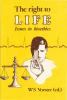
The Right to Life: Issues in Bioethics
Keywords:
Human Rights; Education, rights protection, BioethicsSynopsis
ISBN O 86981 569 5
Contents
Contributors to this volume vi
Preface vii
AP DU TOIT
What is life? 1
D I FERREIRA
Genetic engineering in life 21
MM QUIGLEY
The right to experiment with human life 36
R PRETORIUS
The right to live: Legal aspects 70
L D HULLEY
The right to end life 86
Extract from the Preface
The concept of life has fascinated mankind through the ages. Theories on the origins of the human race, the nature, origin and end of life, whether there is life after death, and how these different aspects interrelate, have been widely discussed over many centuries. In addition to what we learn in the Bible about the views of life of the Jews and early Christians, similar and different ideas about life - all valuable - are found in other religions. Philosophers have grappled with the complexities of the phenomenon and have given many answers to the various questions concerning life. Biologists have come up with the most interesting ideas and theories; so, have medical scientists and many others to whom the concept of life presents tantalising secrets, these different views have given rise to a wide range of bioethical issues, which need to be addressed in terms of our current understanding of life. The emergence of industry and the development of technology have opened up new challenges to humankind and have changed our concept of life. Because of the discovery of the structure of DNA (deoxyribonucleic acid), modern genetic engineering, for example, has enabled scientists to modify genetic material, which has major implications for humankind and its environment. Developments in reproductive technologies, such as in vitro fertilisation, embryo freezing and oocyte donation, have necessitated serious thought by medical scientists, philosophers, ethicists, theologians, jurists and others. These developments are part of our daily experience. At the same time, we are reminded daily of other realities influencing our concept of life and raising questions about the right to life. Malnutrition, poverty, power struggles, oppression, warfare, terrorism, the emergence of new and horrifying diseases such as AIDS, and many other things we experience, influence the way in which we construct reality and how we conceive of life. It is only by considering the challenging complexity of life that we can really start thinking about the right to life. The concern of the organising committee of the twelfth annual seminar of the Institute for Theological Research at Unisa was to offer a forum for those who are interested in the complexities of bioethics from a theological point of view. To this end we invited a number of speakers to prepare papers on a variety of topics about the right to life. To talk meaningfully about bioethics, one has to consider the question 'What is life?'. The answers to this question lead to ideas about the right to life. Being aware of the many possible answers to that question, we decided to invite speakers to tackle the question of the right to life from different angles. This book contains a selection of the papers delivered at the seminar. It addresses a small, but nevertheless important aspect of the problem and clearly indicates the complexity of the right to life and quality of life in our own time.
The views expressed are those of the authors of the essays and not necessarily those of the Institute or the University. I am indebted to many individuals who helped me with the preparation of the seminar and the book. The organising committee, consisting of Jansie Kilian, Hilda Steyn, Klippies Kritzinger and Willie Wessels, was responsible for finding a topical issue, appropriate topics and knowledgeable speakers, and for organising the seminar.
In this connection it gives me great pleasure to thank Professor J V van der Merwe, Dean of the Medical Faculty of the University of Pretoria, who has made it possible for us to have Dr Quigley of Cleveland, Ohio in the USA as one of our speakers. I am also indebted to the authors of the essays contained in the book and to the referees who had to ensure academic quality. Deep appreciation is extended to Jansie Kilian, Hilda Steyn and Beverley van Reenen for their help-in editing the book, and to those who assisted in proofreading the manuscript: Almarie Blaauw, Adrian Blom and Ernst Horn. The manuscript was typed by Nonnie Fouche. My sincere thanks to all of you, including my secretary, Linda Bedingfield.
- W S Vorster